
Search Connecticut Inmate Records
In 1968, Connecticut integrated its state prisons and county jails into a unified prison system under the Connecticut Department of Correction (DOC). The DOC has 18 correctional facilities spread across the state; however, five of these facilities are currently closed due to low offender populations. One of the department's operational facilities (the York Correctional Institution) is designated specially for female offenders. In addition to the DOC's facilities, Connecticut has a federal correctional institution operated by the Bureau of Prisons and two juvenile residential centers managed by the state's judicial branch.
Connecticut has an incarceration rate of 326 per 100,000 people, with an average of 11,000 Connecticuters behind bars. About 90% of these individuals are under DOC custody, with seven percent in federal prison, and the rest in juvenile centers, involuntary commitment, and other kinds of detention facilities. Unlike several other states, Connecticut does not rely on private prisons, and all its inmates are incarcerated in government-operated facilities.
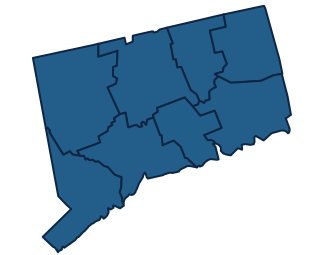


Connecticut Department of Correction Inmate Search
The Department of Correction (DOC) was established in 1968 as the governmental agency responsible for operating Connecticut's prison system. To this end, the department is charged with managing offenders and sentenced inmates and also handling community supervision for eligible offenders released from prison. In line with its duties, the DOC keeps detailed records of all inmates under its custody and provides interested members of the public with several options for accessing these records, in accordance with state law. One such option is the Offender Information Search tool.
Members of the public can access inmate records by running a search on the aforementioned tool using the inmate's name or identification number. Obtainable information includes the inmate's full name, date of birth, status, current location, offense details, and sentencing information, where applicable. It is important to note that a person's current incarceration does not mean that they have been convicted of a crime; this is because Connecticut's prison system also holds individuals awaiting trial.

Find Inmate by Name
Name-based searches are the most convenient option for locating inmates under the custody of the Connecticut Department of Correction. Users simply have to input the first few letters of the inmate's last name into the designated field on the DOC's Offender Information Search tool and then click on the "search all inmates" button to initiate the search. Doing this will return a list of all inmates whose last names begin with the letters typed into the search tool. For example, entering the letters "Rob" into the tool will generate a list of all inmates with the last name "Rob," plus inmates whose last names are "Robert," "Roberts," "Robertson," "Robinson," "Robles," and so on.
As such, it is advisable to type the exact last name (of the inmate of interest) to limit the number of results generated. Search results can further be narrowed by including the inmate's first name and/or date of birth (if this information is handy).

Find Inmate by Number
Number-based searches are an alternative for locating individuals in the Connecticut prison system via the DOC's Offender Information Search tool. Each inmate is assigned a unique CT DOC Inmate Number that is used to identify and track them within the prison system. Performing a number-based search simply involves entering only this number into a designated field and clicking the "search all inmates" button; additional criteria like the inmate's name and date do not have to be provided.
Number-based searches are a more precise option for locating inmates under DOC custody, as the search result only lists the specific inmate with the corresponding number; unlike name-based searches, which typically generate a long list of inmates. However, it also requires the correct inmate number to be inputted, otherwise the search may return a "No Record Meets Your Criteria" message or even bring up information on someone else (whose number matches what was inputted).
Find Inmate by Jail Type
The DOC's Offender Information Search tool does not include jail/prison type in its search criteria options. However, inmate records generated from name and number-based searches on this tool include the current location where the inmate is being held. Contact information, visiting schedules, directions to this location, and other pertinent information can be obtained from the DOC's Facilities webpage. Note that, if the inmate's record lists their location as "PO" followed by a name, this means that the inmate is currently under supervision by a parole officer at a regional parole office.
How Many Inmates Are Currently Incarcerated in Connecticut?
Connecticut has an estimated total incarcerated population of ~12,100 people across state prisons, county jails, federal facilities, private prisons, juvenile facilities, and other detention categories. Because Connecticut operates a unified state correctional system, most jail and pre-trial detention functions are handled by the Connecticut Department of Correction rather than county jails.
| Facility Type | Population | % of Total | Avg. Daily Cost | Capacity Utilization |
|---|---|---|---|---|
| State Prisons | ~8,900 | 73.6% | ~$250 | ~78% |
| County Jails | 0 | 0.0% | N/A | N/A |
| Federal Facilities | ~1,020 | 8.4% | ~$145 | ~82% |
| Private Prisons | 0 | 0.0% | N/A | N/A |
| Juvenile Facilities | ~180 | 1.5% | ~$700+ | ~55% |
| Other / Pre-Trial | ~2,000 | 16.5% | ~$240 | ~70% |
| Total | ~12,100 | 100.0% | ~$250 overall | ~76% |
State Correctional Facilities in Connecticut
Connecticut operates an estimated 13+ major state correctional facilities through a unified Department of Correction system. The system includes prisons, specialty mental health and medical units, a women’s institution, pre-trial detention centers, and community or work-release focused facilities.
| Facility Name | Type | Location | Capacity | Population | Security Level |
|---|---|---|---|---|---|
| MacDougall-Walker Correctional Institution | State Prison | Suffield | ~2,100 | ~1,700 | High / Maximum |
| Cheshire Correctional Institution | State Prison | Cheshire | ~1,500 | ~1,150 | Medium / High |
| York Correctional Institution | Women's Facility | Niantic | ~1,100 | ~700 | All Female Security Levels |
| Garner Correctional Institution | Specialty Facility | Newtown | ~600 | ~520 | High / Mental Health |
| New Haven Correctional Center | Community Corrections Facility | New Haven | ~700 | ~560 | Pre-Trial / High |
| Bridgeport Correctional Center | Community Corrections Facility | Bridgeport | ~800 | ~620 | Pre-Trial / Medium |
| Corrigan-Radgowski Correctional Center | State Prison | Uncasville | ~1,200 | ~890 | Medium / High |
| Osborn Correctional Institution | Medical / Aged Facility | Somers | ~1,500 | ~1,050 | Medium |
| Cybulski Community Reintegration Center | Work Release Center | Enfield | ~500 | ~360 | Minimum / Reentry |
Inmate Demographics & Population Trends in Connecticut
Connecticut’s incarcerated population is largely male and adult, with a substantial share serving sentences for violent, weapons, drug, and property-related offenses. Compared with national trends, Connecticut has reduced its prison population over the past decade, but racial and ethnic disparities remain significant.
| Demographic Category | Breakdown | Notes |
|---|---|---|
| Gender | Male ~93%; Female ~7% | Women are primarily housed at York Correctional Institution, while men are housed across the broader DOC system. |
| Age Groups | 18–24 ~10%; 25–34 ~31%; 35–44 ~28%; 45–54 ~18%; 55+ ~13% | The population has gradually aged as longer sentences and lower admissions reduce the share of younger inmates. |
| Race / Ethnicity | Black ~40%; Hispanic / Latino ~29%; White ~28%; Other / Unknown ~3% | Black and Hispanic residents are incarcerated at rates higher than their share of the state population. |
| Top Offense Types | Violent offenses ~45%; Drug offenses ~13%; Property offenses ~14%; Weapons, public order, and other offenses ~28% | Violent and weapons-related convictions make up a larger share of sentenced prisoners than low-level drug offenses. |
| Avg. Sentence Length | ~4–5 years for sentenced prisoners; longer for violent felony convictions | Pre-trial detainees and short-sentence inmates are included in the unified DOC system, affecting average length-of-stay figures. |
| Recidivism Rate | ~45% rearrest within 3 years; lower rates for reincarceration | Connecticut tracks multiple recidivism measures, including rearrest, reconviction, and return to prison. |
Parole, Release & Reentry Resources in Connecticut
Connecticut provides parole review, community supervision, transitional services, and sentence-credit options through the Board of Pardons and Paroles and the Department of Correction. Reentry support may include housing referrals, employment preparation, benefits assistance, and victim notification services.
| Program / Resource | Description | Who It Serves | Contact / Access |
|---|---|---|---|
| State Parole Board | The Connecticut Board of Pardons and Paroles reviews parole eligibility, grants parole, and handles pardons and commutations. | Eligible sentenced individuals in Connecticut custody and applicants seeking pardons. | Connecticut Board of Pardons and Paroles; applications and hearing information available through ct.gov/bopp. |
| Good Time / Sentence Reduction | Risk Reduction Earned Credits may reduce time served for eligible inmates who comply with programming and behavior requirements. | Eligible sentenced inmates, subject to offense type, sentence rules, and DOC policy. | Connecticut Department of Correction facility records staff or assigned counselor. |
| Parole Supervision | Community supervision includes reporting, treatment conditions, electronic monitoring when ordered, and graduated sanctions. | People released to parole, special parole, or other supervised community placements. | Connecticut Department of Correction Parole and Community Services Division. |
| Reentry Housing | Transitional housing, halfway house placement, and community residential programs support release planning. | People leaving prison who need stable housing or structured community placement. | DOC reentry counselors, parole officers, and contracted community providers. |
| Employment Assistance | Job readiness, vocational training, resume help, and referrals to workforce programs are offered before and after release. | Returning citizens seeking work, training, or credentials. | DOC reentry services, American Job Centers, and community reentry organizations. |
| Benefits Restoration | Assistance may include Medicaid/HUSKY Health enrollment, identification documents, SNAP referrals, and Social Security coordination. | Individuals nearing release or recently released who need public benefits or documentation. | Facility reentry staff, Connecticut DSS, Access Health CT, and local community providers. |
| Victim Notification Program | Connecticut participates in victim notification services that provide custody status updates and release notifications. | Victims, survivors, family members, and registered members of the public. | Connecticut Statewide Automated Victim Information and Notification services, including VINELink where available. |
What Information is Contained in a Connecticut Inmate Record?
Connecticut inmate records generally provide information about offenders, the circumstances surrounding their incarceration, and specific sentence/prison details. This information includes, but is not limited to:
- The inmate's name and CT DOC inmate number
- The inmate's date of birth
- The inmate's current location
- The inmate's status – whether they have been sentenced or accused (unsentenced)
- The inmate's controlling offense – this is the primary offense for which they were sentenced/accused
- The inmate's admission date into the DOC
- The inmate's sentencing date and maximum sentence, where applicable
- The inmate's maximum release date, estimated release date, and special parole end date, where applicable. Parole is a conditional release whereby an eligible offender serves out their sentence outside prison but under the DOC's supervision. While an inmate's maximum sentence date is usually fixed, their estimated release and special parole end dates are subject to change and dependent on a number of factors, such as the inmate's eligibility for parole and behavior while incarcerated.
In addition to this information (which is generally accessible online), the DOC may also provide interested parties with details like the inmate's photograph, correctional history, and disciplinary history.
Connecticut Inmate Records by Counties
Unlike most states that have distinct state-level prisons and local jails, Connecticut operates a unified prison system, meaning that state and local offenders are both overseen by the DOC. As such, there are no local jails in Connecticut, and all inmates – including pre-trial offenders and sentenced offenders – are housed in DOC-operated facilities.
To this end, records of all inmates in the state (excluding offenders in federal prison) can be accessed through the Offender Information Search tool that the DOC provides for this purpose.
Are Incarceration Records Public Information in Connecticut?

Public records, as defined by the Connecticut Freedom of Information (FOI) Act, refer to any recorded information (regardless of its physical form) that a public agency creates, owns, uses, receives, keeps, or is entitled to receive, as part of its official activities. Per this act, incarceration records are generally considered public records in Connecticut, meaning that interested members of the public have the right to view and obtain copies of these records.
Notwithstanding this, the FOI Act also exempts certain incarceration-related information from being disclosed to the public. These include juvenile offender records, information concerning confidential informants and witnesses, inmates' medical files, and any other similar information that would constitute an invasion of personal privacy if disclosed.
Federal Prisons in Connecticut
The United States federal prison system was formally established in 1891; today this system comprises over 120 correctional facilities nationwide housing offenders convicted of federal crimes. There is currently one such facility in Connecticut (note that this facility is managed by the Federal Bureau of Prisons, not the Connecticut Department of Correction):
Interested members of the public can obtain information on offenders housed in this facility by utilizing the BOP's inmate locator tool to perform a name or number-based search for the inmate of interest. Users can include criteria like the inmate's race, age, and sex when running a name-based search to narrow down results, while number-based searches can be done using either a BOP register number, DCDC number, FBI number, or INS number. However, it is important to note that this tool only provides information on federal inmates who were incarcerated from 1982 – to date.
| Prison Name | Location | Total Inmate Population | Security Level | Notes |
|---|---|---|---|---|
| Federal Correctional Institution (FCI), Danbury. | Danbury | 1,252 | Low Security | FCI Danbury is a co-ed facility, meaning that it holds both male and female offenders. The facility has an adjacent minimum security satellite camp that houses approximately 9% of its total population. |
Frequently Asked Questions about Inmate Records
Answers to some commonly asked questions concerning looking up inmate records in Connecticut are provided below:
You can submit requests for public records to the Connecticut Department of Correction online or by contacting the department's Public Information Office at:
24 Wolcott Hill Road
Wethersfield, CT 06109
Phone: (860) 692-6290
Note that the payment of a fee may be required to obtain copies of these records.
The DOC provides an Offender Information Search tool that can be used to look up inmates in Connecticut online. This includes pre-trial offenders and individuals who have been sentenced.
You can find old inmate records in Connecticut by contacting the facility where the inmate was held. Queries can also be directed to the DOC's Public Information Office at (860) 692-7480 or via email .
You may access an inmate's death records by contacting the facility that housed the inmate. You can also obtain certified copies of an inmate's death certificate through state and local Vital Records Offices. Note that local offices only keep records of deaths that occur within their jurisdiction. Also, Connecticut death certificates with the decedent's Social Security number included can only be accessed by their spouse or next of kin.
It may take up to 24 hours for inmate information to be published/updated on the state's Offender Information Search tool, as the DOC typically updates its database daily.
The Connecticut Department of Correction provides the following options for sending money to inmates under its custody:
- Electronic deposits via JPay , TouchPay , and Western Union
- U.S. Mail. Individuals who wish to use this option will be required to complete and mail an Inmate Trust Fund Remitter Form , along with the funds, to:
Inmate Trust Fund
P.O. Box 290800
Wethersfield, CT 06129-0800
Payments can be made in any of the following forms:
- Money orders or certified/cashier's checks (these must be made payable to the inmate)
- Attorney checks (a cover letter should also be included)
- Employer checks (this should be sent along with a pay stub)
- Refund checks from vendors
- Social Security and Social Services checks
- Unemployment checks
- Tax refunds
- Veterans' Administration checks
Note that you do not have to be on an inmate's visitor list to send them money. Queries concerning information on an inmate's account can be directed to (860) 692-7670.